
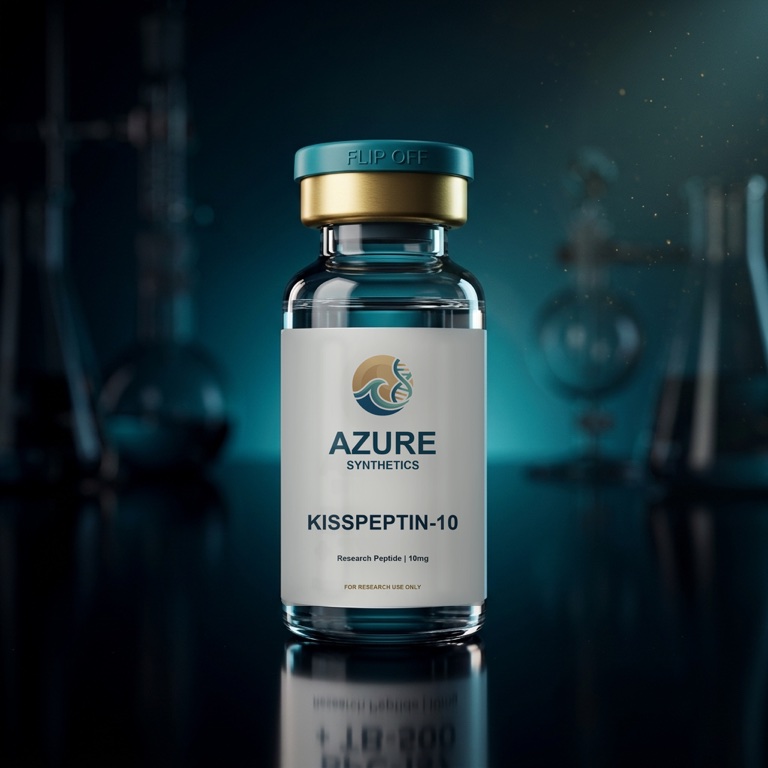
GH-axis research
Kisspeptin-10
Gevriesdroogd endocriene signaleringsonderzoekpeptide voor systeembeoordeling
 View current COALinked product documentation
Free standard shipping to eligible destinations · estimated 7–11 business days after dispatch
Not a drug, food, dietary supplement, cosmetic, or medical product. Not for human or veterinary consumption. Not intended to diagnose, treat, cure, mitigate, or prevent disease. These materials have not been evaluated by the U.S. Food and Drug Administration.
Batch-linked certificate support is available through the documentation desk.
Open current COAReceive optional catalog and documentation updates. You can withdraw at any time.
Get catalog updatesProduct record
Specifications and documentation
- Product identity
- Kisspeptin-10
- CAS number
- Available in product documentation
- Molecular weight
- Available in product documentation
- Purity / assay
- 98.7%-99.3%
- Vorm
- Gevriesdroogd poeder
- Configuration
- 5 mg
- Opslag
- Afgesloten, koud, droog en beschermd tegen hitteschommelingen bewaren. Bevestig productspecifieke opslag bij aankomst.
- Analysecertificaat
- Direct COA available below
Molecular class
10-residue KISS1R ligand fragment
Sequence / composition
Tyr-Asn-Trp-Asn-Ser-Phe-Gly-Leu-Arg-Phe-NH2, the receptor-active carboxyl-terminal kisspeptin fragment.
Research design note
It is a focused KISS1R / GPR54 probe; short half-life and pulsatile signaling shape experimental interpretation.
External reading
Literature for context
Third-party sources describe their own research materials and methods. They do not validate a specific Azure catalog batch.
Keep comparing
Compare other catalog records.
Explore related research materials. These are not a combined-use recommendation.
-
Dermal
 Public product preview
MT-2
Melanotan II is a melanocortin receptor research peptide connected to pigment, appetite, and central melanocortin-pathway literature.
-
Dermal
 Public product preview
MT-1
Melanotan I / afamelanotide is an alpha-MSH analog research peptide tied to melanocortin receptor and pigment biology literature.
-
Incretin research
 Public product preview
AZ-GLP2(T)
Tirzepatide is a dual GIP / GLP-1 receptor agonist reference point in metabolic research and comparative incretin pharmacology.