
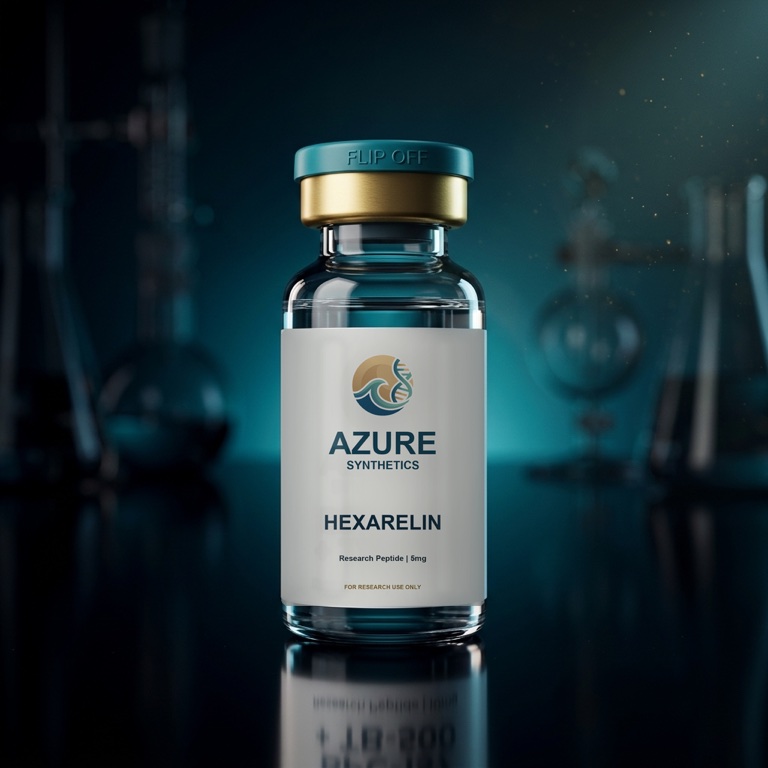
Endocrine signaling research
Hexarelin
Gevriesdroogd endocriene signaleringsonderzoekpeptide voor systeembeoordeling
Hexarelin is a synthetic GH secretagogue research peptide studied in endocrine and cardiometabolic signaling models.
Support can confirm any currently available COAs or batch documentation for this product.
Request available documentsConfirm an optional email signup to receive a single-use 10% welcome code.
Get catalog updatesAlleen voor laboratoriumonderzoek. Niet voor menselijk of diergeneeskundig gebruik. Niet bedoeld voor het diagnosticeren, behandelen, genezen, verzachten of voorkomen van ziekten.
Afgesloten, koud, droog en beschermd tegen hitteschommelingen bewaren. Bevestig productspecifieke opslag bij aankomst.
Verpakt voor stabiliteit tijdens het transport, met bestelondersteuning beschikbaar voor routes bij warm weer.
Batch-linked certificate support is available through the documentation desk.
Onderzoekscontext
Hexarelin onderzoeksprofiel
Hexarelin is a synthetic hexapeptide growth hormone secretagogue studied at the ghrelin receptor. Research includes GH-release response, receptor potency, endocrine markers, desensitization, and experimental cardiac or metabolic signaling observations. It is often compared with GHRP-2, GHRP-6, and ipamorelin to examine differences in potency and selectivity, while GHRH analogs such as sermorelin and CJC-1295 provide a separate receptor pathway for comparison. Hexarelin is most appropriate when a study specifically needs this GHS-R ligand rather than a general GH-axis material. Much of the broader mechanistic evidence is preclinical or early-stage and should remain tied to its original model.
Voorgesteld mechanisme
A potent synthetic GHS-R1a agonist that stimulates GH release through pituitary and hypothalamic pathways. Additional cardiac and cytoprotective mechanisms have been proposed in preclinical studies, some potentially independent of GH.
In studies gerapporteerde effecten
- Human pharmacology studies reported strong acute GH release and endocrine responses after hexarelin exposure.
- Animal and cell studies reported changes in cardiac function, survival signaling, fibrosis, and tissue-injury markers.
- Repeated exposure can cause desensitization, and cardiac findings remain largely preclinical and mechanism dependent.
Veelgebruikte onderzoekseindpunten
GHS-R potency, GH, ACTH, cortisol, prolactin, receptor desensitization, cardiac contractility, fibrosis, apoptosis, inflammatory markers, and pharmacokinetics.
Bewijs en beperkingen
Human evidence primarily addresses acute endocrine pharmacology; proposed cardiac effects are largely preclinical and not established as human outcomes.
External reading
Literature for context—not product proof.
Third-party sources describe their own research materials and methods. They do not validate a specific Azure catalog batch.
Support and documentation
Questions about this product?
What documentation can I request before ordering?
Before ordering, contact support with the product name, selected format, andu2014if availableu2014an order or batch reference to request available batch-linked documentation.
What should I confirm before ordering?
Compare the product name, listed amount, physical form, storage note, price, and documentation route. When the order arrives, match the product and lot or batch reference to the order record and available documentation.