
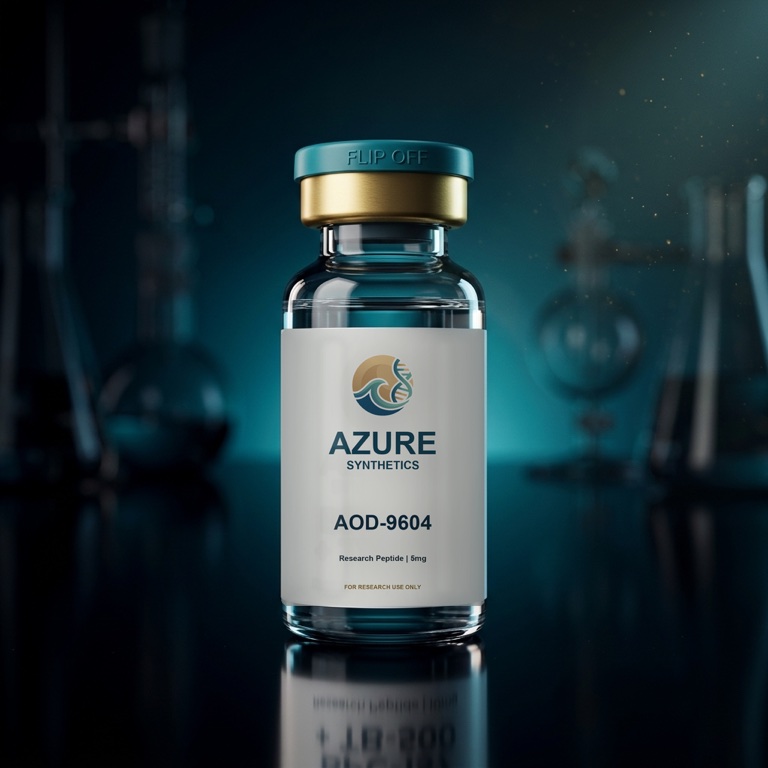
Metabolic research
AOD-9604
Lyophilized metabolic research compound
AOD-9604 is a modified fragment of human growth hormone 176-191 studied in GH-fragment and lipid-metabolism signaling models.
Support can confirm any currently available COAs or batch documentation for this product.
Request available documentsConfirm an optional email signup to receive a single-use 10% welcome code.
Get catalog updatesSolo per ricerca di laboratorio. Non per uso umano o veterinario. Non destinato a diagnosticare, trattare, curare, mitigare o prevenire malattie.
Conservare sigillato, freddo, asciutto e protetto dagli sbalzi di calore. Conferma lo stoccaggio specifico del prodotto all'arrivo.
Imballato per garantire la stabilità del transito con supporto per gli ordini disponibile per le rotte con clima caldo.
Batch-linked certificate support is available through the documentation desk.
Contesto di ricerca
Profilo di ricerca AOD-9604
AOD-9604 is a modified peptide based on the 176-191 region of human growth hormone. It is studied separately from full-length HGH because research questions generally focus on fragment-specific lipid-metabolism and adipocyte signaling rather than the complete growth-hormone receptor program. Common models examine lipolysis, lipogenesis, fat-cell metabolism, body-composition markers, and whether the fragment retains selected metabolic signals without reproducing all actions of the parent hormone. The evidence base includes laboratory, animal, and limited human research with mixed conclusions. It is best selected for GH-fragment comparisons, not as a substitute for HGH, GHRH analogs, or ghrelin-receptor secretagogues.
Meccanismo proposto
A modified peptide derived from the 176-191 region of human growth hormone. The proposed mechanism is fragment-specific regulation of adipocyte lipid metabolism, including increased lipolysis and reduced lipogenesis, without reproducing the full growth-promoting signaling profile of intact HGH.
Effetti riportati negli studi
- Cell and animal models reported increased fat breakdown, reduced fat synthesis, and reduced adiposity under selected experimental conditions.
- Human obesity studies did not consistently demonstrate a clinically convincing weight-loss effect.
- The literature does not establish that the fragment reproduces the broader anabolic or endocrine effects of full-length growth hormone.
Endpoint di ricerca comuni
Adipocyte lipolysis and lipogenesis, glycerol release, fat mass, body mass, glucose and IGF-1 markers, receptor independence, and comparison with intact HGH.
Evidenze e limiti
Preclinical findings are stronger than the mixed human efficacy record. The proposed lipid effects remain model dependent and should not be presented as an established human outcome.
External reading
Literature for context—not product proof.
Third-party sources describe their own research materials and methods. They do not validate a specific Azure catalog batch.
Support and documentation
Questions about this product?
What documentation can I request before ordering?
Before ordering, contact support with the product name, selected format, andu2014if availableu2014an order or batch reference to request available batch-linked documentation.
What should I confirm before ordering?
Compare the product name, listed amount, physical form, storage note, price, and documentation route. When the order arrives, match the product and lot or batch reference to the order record and available documentation.